
Views: 0 Author: Site Editor Publish Time: 2026-05-05 Origin: Site

Investing in a luxury parquet layout significantly elevates any interior space. However, the stakes of this decision remain incredibly high. Both Herringbone Flooring and Chevron Flooring represent premium architectural choices. They transform ordinary rooms into stunning focal points. But selecting the wrong pattern for your specific floor plan can trigger unexpected budget overruns. It often creates visual clutter in poorly matched environments. Buyers frequently confuse these two iconic styles. Yet, they rely on entirely distinct geometric rules. These underlying structural differences drastically alter material waste, dictate specific labor costs, and shift overall room dynamics. You need clear facts before committing to a final purchase. This guide provides an evidence-based comparison of structural mechanics, hidden installation realities, and distinct spatial impacts. You will learn exactly how to weigh stability against modern aesthetics. Ultimately, this breakdown helps you make a confident, architecturally sound decision for your next renovation project.
Structural Cut: Herringbone utilizes standard rectangular planks laid at 90-degree angles; Chevron requires precision-cut planks (typically 45 or 60 degrees) to form a continuous, sharp "V" point.
Cost Differential: Chevron is generally 10% to 30% more expensive than Herringbone due to complex manufacturing and higher material waste (15–20% vs. 10–15%).
Stability: Herringbone offers superior structural stability due to its staggered, interlocking mechanical layout (originally used in Roman engineering).
Spatial Impact: Chevron creates a directional pull that elongates narrow spaces; Herringbone adds multidirectional depth and richness to wide or traditional rooms.
Implementation Risk: Neither pattern is suitable for DIY. Both require flawlessly leveled subfloors, as geometric layouts magnify even millimeter-level imperfections.
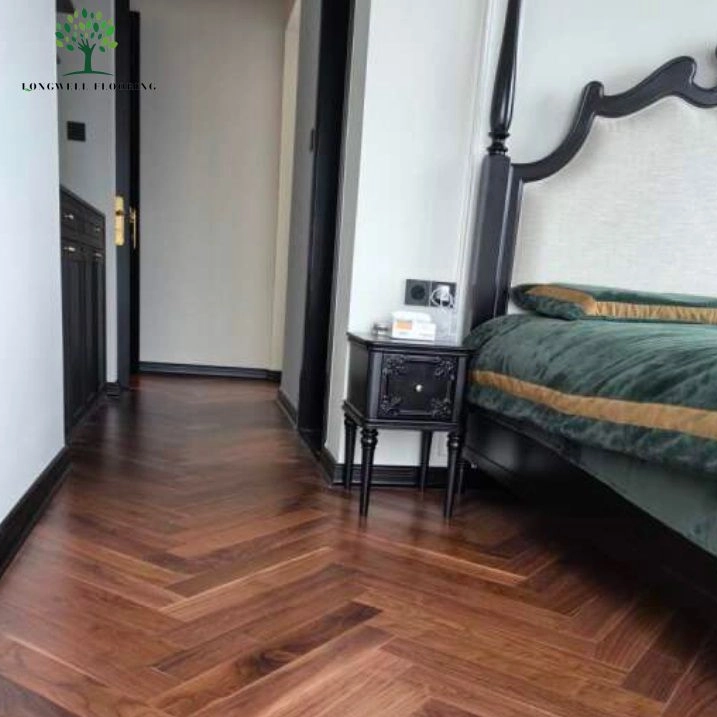
Herringbone relies on standard rectangular boards. Installers lay these planks at strict 90-degree angles. The end of one board butts squarely against the side of another. This creates a staggered, overlapping arrangement often described as a "broken" zig-zag. The visual rhythm shifts constantly as light catches the alternating wood grains.
This layout offers a massive mechanical advantage. The interlocking joints naturally distribute heavy foot traffic loads. They resist seasonal shifting remarkably well. Ancient Roman road builders originally engineered this specific pattern, known as opus spicatum, to stabilize heavy stone pathways. Today, it remains one of the most dimensionally stable parquet layouts available.
However, procurement presents a unique logistical reality. You cannot execute this pattern using a single type of board. You must order specific "Left (A)" and "Right (B)" boards. Installers need equal quantities of both to weave the pattern correctly. A common mistake involves ordering standard straight planks and assuming installers can simply turn them. Precision parquet requires factory-milled A and B locking mechanisms to ensure the structural integrity holds tight over decades.
Chevron abandons the standard rectangle. Instead, manufacturers custom-cut the ends of every single board at a precise angle. They typically use 45-degree or 60-degree cuts. When installers join these angled ends together along a central spine, they meet perfectly. This forms a continuous, sharp "V" shape.
The visual result feels distinctly different from Herringbone. The uninterrupted zig-zag creates incredibly strong directional lines. It delivers a highly contemporary, streamlined aesthetic. The eye naturally follows the unbroken central seam.
This perfection demands a harsh manufacturing reality. The precise mitered cuts require highly specialized milling equipment. Factories must calibrate their saws perfectly. During installation, this reduces the margin for error to near zero. If two boards meet with even a half-millimeter discrepancy, the continuous "V" breaks. The flaw cascades down the entire room, forcing installers to rip out the row and start over.
You must understand the raw cost differences before comparing bids. Chevron fundamentally costs more to manufacture. Factories waste more raw timber cutting specific angles into every plank. Consequently, you will typically see a 10% to 30% base price premium compared to identical wood species cut into rectangles.
Waste factors during installation also diverge sharply. Standard straight-plank floors usually require a 5–7% overage allowance. Parquet layouts demand much more. You should factor in a standard 10–15% overage for Herringbone. Expect a steeper 15–20% overage for Chevron Flooring. Installers waste a significant amount of material cutting complex alignment angles near walls and perimeters. Failing to order enough material upfront forces you to buy a second batch. This risks mixing dye lots and ruining the color consistency of your room.
Comparison Metric | Herringbone Layout | Chevron Layout |
|---|---|---|
Board Geometry | Standard Rectangles (A & B) | Angle-Cut (Typically 45° or 60°) |
Material Overage Rate | 10% - 15% Recommended | 15% - 20% Recommended |
Base Material Cost | Standard Premium Pricing | 10% - 30% Higher Premium |
Visual Characteristics | Broken, overlapping zig-zag | Sharp, continuous directional V |
Subfloor preparation highlights a critical implementation risk. Parquet patterns remain utterly unforgiving. A standard straight-plank floor can occasionally bridge a minor dip in the subfloor. Geometric patterns cannot. Any dip, crown, or wave in the concrete or plywood will force the geometric points to separate.
These gaps magnify quickly. A one-millimeter height difference on the subfloor translates to an obvious visible gap at the surface joints. You must demand perfect leveling prior to installation. Contractors usually pour self-leveling compounds (SLU) to achieve a glass-flat surface. You should explicitly check if your initial quote includes this intensive prep work. Many low bids exclude it, leading to massive surprise charges on day one.
Labor costs multiply when finishing the edges of a room. You rarely run a geometric zig-zag straight into a rough drywall edge. Cutting tiny, complex triangles to sit flush against baseboards requires immense patience and highly skilled labor.
To solve this, professionals often install a dedicated border plank. They frame the entire perimeter of the room with a straight board. Sometimes they add a thin, contrasting feature strip. This frames the geometric pattern beautifully. It makes the installation look intentional and finished. However, custom borders demand meticulous scribing around doorways, fireplaces, and curved walls. You must budget for this specialized craftsmanship.
Chevron acts as a powerful architectural arrow. The continuous center seams draw the eye forward along a specific axis. You should deploy this aggressively in tight or challenging floor plans.
It works best in narrow hallways, galley kitchens, or compact bedrooms. The sharp points visually push the side walls outward. It elongates the room, making short spaces feel expansive. You can control the intensity of this pull by choosing the cut angle. A 45-degree angle creates a wider, softer appearance. A 60-degree angle creates a sharper, faster visual flow down the room.
Sometimes you do not want to force the eye in a single direction. Herringbone disperses visual focus effectively. The broken, alternating planks scatter light in multiple directions simultaneously.
This multidirectional depth proves ideal for large, open-concept living areas. Grand entryways and wide dining rooms benefit immensely. Herringbone Flooring builds rich, intricate texture without overwhelming the architecture. It grounds a massive room, making it feel warm and intentionally designed.
You must also consider practical daily life. Families with pets or heavy foot traffic should note a distinct advantage here. The complex, broken lines of a staggered layout naturally camouflage surface wear.
Dust, minor scuffs, and small scratches get lost in the busy, overlapping visual field. It essentially acts as optical camouflage. Conversely, Chevron relies heavily on absolute symmetry. When a prominent scratch crosses those perfectly aligned, continuous V-joints, it interrupts the perfection immediately. The sharp aesthetics make minor imperfections much more noticeable.
We strongly recommend engineered hardwood over solid wood for all parquet applications. Engineered planks feature a multi-ply core beneath a thick top veneer. This core provides essential dimensional stability.
Solid wood inherently fluctuates. It expands during humid summers and contracts during dry winters. In a straight-plank floor, this movement causes minor gapping. In a tight geometric pattern, seasonal movement destroys the precisely aligned seams. The points buckle, cup, or pull apart completely. Engineered hardwood mitigates this risk entirely, keeping your geometric lines perfectly sharp year-round.
The market dictates material availability based on manufacturing ease. Because Herringbone Flooring relies on simple 90-degree rectangles, alternative materials thrive here. You can easily find high-quality Luxury Vinyl Tile (LVT) and laminate options in this pattern. They offer excellent durability, total waterproofing, and highly affordable price points.
Sourcing budget-friendly alternatives for an angled pattern proves much harder. The necessary 45-degree cuts disrupt standard automated manufacturing lines. Finding a high-quality, authentic-looking LVT with custom-mitered ends remains a challenge. You will generally pay a premium even in the synthetic categories.
Ceramic and porcelain tile applications introduce a notable exception. In wet zones like bathrooms or mudrooms, wood flooring simply fails. Wood-look tiles bridge this gap.
Tile manufacturers recognize the installation nightmares associated with tiny, angled cuts. Therefore, they frequently sell Chevron tiles pre-mounted on fiberglass mosaic mesh sheets. The factory perfectly aligns the "V" joints beforehand. Installers simply lay the 12x12 sheets side by side. This guarantees flawless alignment and drastically reduces installation labor costs.
Your final choice bridges architectural intent with budget realities. Review the precise scenarios below to align your goals with the correct material.
Choose Herringbone Flooring if:
You want a timeless, historically grounded aesthetic that suits both transitional and traditional interiors.
You require a highly stable, mechanically interlocked floor to withstand heavy, daily foot traffic.
You have a slightly tighter budget but still want a distinct luxury parquet appearance.
You have a large, wide-open living space and want to build visual texture without creating a "runway" effect.
You are considering highly durable, waterproof alternatives like LVT or laminate.
Choose Chevron Flooring if:
You are aiming for an ultra-modern, high-end European aesthetic with sharp, clean lines.
Your primary architectural goal is to visually lengthen a specific room, narrow corridor, or galley kitchen.
You have the budget flexibility to absorb premium manufacturing costs and higher material waste factors.
You have access to top-tier, specialized parquet installers capable of flawless, millimeter-perfect alignments.
You prefer the aggressive, continuous arrow motif over a broken, staggered layout.
Selecting the right geometric pattern dictates the entire mood of your interior. The decision ultimately balances your desired architectural intent with your practical budget reality. You must remember that the true cost of either floor extends far beyond the price of the wood. The hidden expenses lie in meticulous subfloor preparation, specialized labor, and specific material waste factors.
We heavily advise against purchasing sight unseen. You should order physical samples of both patterns. Place them in your room and observe how the natural lighting interacts with the grain directions throughout the day. Finally, secure site-specific quotes from certified parquet installers before ordering materials. Ensure their bids explicitly cover comprehensive subfloor leveling and complex border treatments. Taking these deliberate steps guarantees a flawless, long-lasting investment.
A: No. Both are centuries-old patterns with permanent historical relevance. They are not fleeting trends. Current market movements favor matte finishes, wire-brushed textures, and lighter European White Oak. These modern finishing techniques perfectly bridge the gap between classic geometric structure and contemporary interior design.
A: It is highly discouraged. Parquet patterns are exceptionally unforgiving. The compounding nature of geometric errors means a one-millimeter mistake in the first row will ruin the alignment of the entire room. Subfloor leveling also requires advanced skills. Professional installation is heavily advised for both patterns.
A: Yes, parquet flooring is universally recognized as a premium architectural upgrade. While it requires a noticeably higher upfront investment than standard straight planks, it significantly elevates the perceived market value. It adds undeniable architectural credibility and luxury appeal to a property, which frequently attracts high-end buyers.


