
Views: 0 Author: Site Editor Publish Time: 2026-03-19 Origin: Site

Is installing Oak Flooring really simple? Many issues start before installation, not after. Poor site conditions and wrong methods often cause failure. This article focuses on proper planning and correct installation.
You will learn how to prepare the site, choose the right method, and install Oak Flooring step by step. We also cover common mistakes and long-term care for better performance.
The first step is always the site itself. Before any carton is opened, the building should be enclosed, dry, and climate-controlled. Windows and doors should already be installed, and wet work such as drywall, painting, plaster, masonry, and concrete curing should be complete. If these steps are skipped, the floor may absorb extra moisture before installation even begins. That can lead to swelling, cupping, or visible movement later.
Temperature and humidity matter just as much. In most cases, indoor temperature should stay around 60–75°F, and relative humidity should remain near 30–50%. These conditions should be stable for several days before the floor arrives and stay stable during installation. If the HVAC system is not running yet, the site is usually not ready for Oak Flooring. This is especially important in new construction, basements, and projects completed during humid or cold seasons.
A floor is only as reliable as the surface below it. The subfloor must be clean, flat, dry, and structurally sound. Dust, paint residue, old adhesive, protruding fasteners, or loose panels can all affect the finished result. Wood and concrete subfloors each need different checks, but the rule stays the same: if the base is unstable, the top floor will not perform well.
Flatness is especially important. A subfloor does not need to be perfectly level, but it does need to be reasonably flat. If there are high spots, they should be sanded or ground down. If there are low spots, they should be filled using the right leveling compound. On wood subfloors, squeaks and movement should be fixed before installation. On concrete, moisture testing is essential, because a slab can look dry and still release enough vapor to damage Oak Flooring.
Acclimation is often misunderstood. It does not simply mean leaving boxes in the room for a few days. It means letting the flooring adjust to the actual indoor environment where it will be used. In many normal interiors, engineered oak can acclimate within two to five days, while solid oak may require more time depending on species, board width, and local climate.
The goal is moisture balance. The flooring, the subfloor, and the room should move toward compatible conditions before installation starts. If the floor is installed while these conditions are still far apart, the boards may shrink, expand, or distort later. For that reason, installers should use a moisture meter, not guesswork, when preparing Oak Flooring for installation.
Good tools do not guarantee a good floor, but poor tools often create poor results. Most oak flooring projects need a tape measure, chalk line, tapping block, pull bar, spacers, saw, straight edge, safety glasses, and a moisture meter. Depending on the method, the project may also require adhesive, trowels, underlayment, nailers, or fasteners. A tapping block is especially important on prefinished flooring because direct hammering can chip the edges.
It also helps to prepare touch-up materials before the job begins. Small filler, markers, or color-matched repair products can save time when handling minor nicks or small edge marks. For installers and procurement teams, a simple checklist reduces missed items and keeps the installation of Oak Flooring more predictable.
Pre-Installation Check | Why It Matters | Typical Action |
Room climate | Prevents movement after install | Stabilize HVAC 5–7 days |
Subfloor flatness | Reduces hollow spots and gaps | Sand highs, fill lows |
Moisture testing | Prevents cupping and warping | Test slab and flooring |
Acclimation | Balances board moisture | Condition materials on site |
Tool readiness | Improves speed and quality | Prepare full install kit |
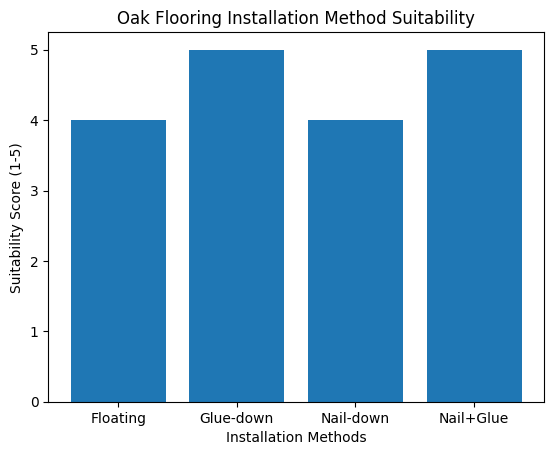
Floating installation is often chosen for speed and convenience. The boards connect to each other rather than being fixed directly to the subfloor with nails or full-spread adhesive. This method works well in many apartments, renovation jobs, and DIY-friendly situations, especially when engineered Oak Flooring is being used.
Its main advantage is flexibility. It can go over several subfloor types and often uses an underlayment layer that improves sound control and comfort. Still, floating floors usually demand tighter flatness standards. If the subfloor is uneven, the floor may feel hollow, move too much, or separate at the joints. It is a practical method, but it is not a shortcut around preparation.
Glue-down installation bonds the flooring directly to the subfloor using approved adhesive. It is often the preferred method over concrete and is widely used where sound control, stability, or radiant heat compatibility matter. When done well, it creates a solid feel underfoot and reduces movement between boards.
This method requires careful work. The adhesive must match the flooring and the subfloor, and open time must be respected. Installers must also remove adhesive residue during the job, not after it hardens. For engineered Oak Flooring, glue-down installation is often one of the strongest technical choices in modern homes and multi-unit projects.
Nail-down installation is common for solid oak over wood subfloors. It provides strong mechanical fastening and has been used successfully for many years. It is a good fit when the project uses plywood or OSB and the installer has access to the right nailing tools.
This method is not ideal for every room. It usually works best above grade and over suitable wood subfloors. Wide planks may need extra support, and poor fastening technique can lead to squeaks, edge damage, or uneven seating. Still, for traditional solid Oak Flooring, nail-down remains a trusted method when the site and product are compatible.
Some projects need more than one type of support. Nail-and-glue installation combines mechanical fastening and adhesive, often to improve stability and reduce movement or noise. It is especially useful for wider planks that place more stress on the system.
This method can increase labor and material cost, but it also improves performance in many demanding applications. For projects where the goal is a quieter, more secure floor, especially with wide engineered Oak Flooring, the combination method can be the most balanced option.
The best method depends on the structure below, the flooring above, and the expectations of the project. Concrete slabs usually point toward glue-down. Wood subfloors often support nail-down. Apartments or lighter renovation jobs may favor floating systems. Wide planks often benefit from glue assistance or full glue-down support.
The decision is not only technical. It also affects labor time, equipment, sound control, and risk. For both residential and commercial buyers, matching the method to the project is one of the most important choices in a successful Oak Flooring installation.
A clean installation starts with a clean layout. Before boards are fixed, installers should decide the board direction, confirm the starting wall, and snap a straight reference line. In many rooms, boards run parallel to the longest wall or the main source of light. The goal is not only visual. Good layout planning also reduces awkward cuts and helps the room feel more balanced.
Board variation should also be planned early. Open several cartons and blend them during installation so the natural color and grain variation looks intentional. At the same time, leave the correct expansion gap around the perimeter and around vertical obstructions. Without that space, Oak Flooring may buckle when humidity rises.
The first row sets the standard for every row after it. If it starts out of line, the whole floor may drift. Use spacers to hold the expansion gap and check alignment carefully before moving on. On some installations, the first row must be face-nailed, backer-supported, or dry-laid first depending on the chosen method.
This row often takes more time than expected. That is normal. A straight, stable first row makes the rest of the installation faster and cleaner. A rushed first row creates correction problems later across the entire Oak Flooring surface.
As rows continue, end joints should be staggered to create both strength and a natural appearance. Avoid visible repeating patterns such as H-joints. Use a tapping block rather than striking the board directly, and keep each row tight before moving forward.
Installers should check spacing often rather than assume the floor is staying straight. Small alignment issues grow as the room progresses. On wide spaces, repeated checks help maintain a cleaner and more professional Oak Flooring result.
Door casings, pipes, floor vents, and transitions often decide whether a floor looks finished or not. Boards should be measured carefully and cut accurately around these features. Door trims are usually undercut so the board slides below for a cleaner finish.
Never force a board into a tight space. That can stress the joint, damage the finish, or block needed expansion. A careful fit makes Oak Flooring look built into the room rather than placed on top of it.
After the last boards are laid, spacers are removed and the perimeter is covered using baseboards or skirting. Transition pieces are added where the floor meets tile, carpet, or another room. The finished floor should then be cleaned, checked for adhesive residue, and inspected for loose boards, edge damage, or visible gaps.
At this stage, the job is not just about appearance. It is also about confirming performance. If issues are found, they should be corrected before the site is handed over. Final inspection is part of a complete Oak Flooring installation, not an optional extra.
Moisture is one of the most common causes of flooring failure. Without testing, installers are making assumptions about the slab, the subfloor, and the flooring itself. That can lead to cupping, gapping, edge lift, or adhesive failure. Moisture meters and slab tests are not optional on professional work. They are part of basic risk control.
Wood moves. Even engineered products move to some degree. If the expansion gap is too small, the floor may press against walls and buckle. If it is too large, the gap may remain visible or weaken the finish around the perimeter. The correct gap depends on board thickness, room size, and installation method, but it must always be planned and protected.
A dirty or uneven subfloor creates problems fast. Hollow spots, movement, poor adhesion, and visible surface irregularities often begin here. Cleaning, flattening, and securing the subfloor can feel slow, but skipping those steps makes later repair much more expensive.
Many board-edge problems happen because the wrong tool is used in the wrong way. Direct hammering can damage locking systems or chip the finish. The wrong adhesive can cause bond failure or moisture-related damage. Good Oak Flooring deserves correct tools and method-specific materials.
Concrete requires extra caution. The slab should be fully cured, tested for moisture, and checked for flatness before installation begins. In most cases, engineered Oak Flooring is the safer choice over concrete because it handles slight environmental variation better than solid boards.
Approved adhesive or a moisture barrier system may also be required depending on site conditions. Even when a slab appears dry, it may still release vapor, so slab testing should always guide the decision.
Radiant heating can work well with oak flooring, but the system must be controlled carefully. Engineered boards are usually preferred because they provide more stability. Temperature changes should be gradual, and surface temperature should generally stay below 82°F.
Dry heat can also reduce indoor humidity, so the room environment must be managed throughout the year. Without that control, Oak Flooring over radiant heat may show shrinkage, checking, or joint separation.
Wide planks create a premium, modern look, but they also require more stability. Because the boards are wider, they react more visibly to movement and place more demand on the installation method. Glue assist, full glue-down, or nail-and-glue systems are often recommended depending on the product.
Expansion planning is especially important here. If wide-plank Oak Flooring is installed without enough environmental control or without a suitable method, the visual impact of movement can be much greater.
A floor still needs protection after the last board is placed. Glue-down installations often require a no-traffic window of about 24 hours, depending on the adhesive. Any residue should be removed right away using approved products. Before handover, the installer should also check for board movement, visible gaps, and finish marks.
Routine care is simple but important. Sweep or vacuum regularly to remove grit, and use a lightly damp mop with a cleaner made for wood floors. Excess water should always be avoided. Even durable Oak Flooring can suffer if moisture sits on the surface too long.
Furniture pads, rugs in high-traffic areas, and steady indoor humidity all help protect the floor. Shoes with abrasive dirt or sharp heels can speed up wear. A stable indoor climate also helps control wood movement over time. Maintenance is not separate from installation quality. It is part of keeping the installation successful.
A strong Oak Flooring result depends on proper planning and control. Site condition, subfloor quality, acclimation, and method choice all shape long-term performance and stability. A clear process helps reduce risk, improve durability, and ensure a clean finish. LongWell Home Materials Co., Ltd. provides reliable oak flooring solutions designed for consistent quality, easy installation, and long-term value in modern projects.
A: Oak Flooring installation is the process of laying boards correctly for stability and durability.
A: Proper Oak Flooring preparation includes subfloor checks, moisture testing, and acclimation.
A: Moisture affects Oak Flooring performance and can cause warping or gaps.
A: The best Oak Flooring method depends on subfloor type and project conditions.
A: Oak Flooring cost varies by material, method, and labor requirements.


